
AI prospecting for sales teams is now part of daily selling. Sellers use AI to research accounts, spot opportunities and draft messages in minutes. But speed alone does not win meetings. A message that sounds like every other AI email gets ignored. In this guide, we show where AI helps, where your people must lead, and a five-step workflow you can start using this week.
What is AI prospecting for sales teams?
AI prospecting is the use of AI tools to support the early stages of selling: finding the right accounts, researching them, spotting buying signals and preparing relevant outreach. AI does the preparation faster. The seller still decides who to contact, what to say and how to build trust in the conversation.
Think of AI as a fast research assistant. It can summarise, suggest and draft. It cannot sit across from a buyer and earn their confidence. That part stays with your people.
In our Sales Mastery Framework™, prospecting sits in the Attract stage. The framework has five stages: Attract, Diagnose, Influence, Commit and Grow. AI supports all five, while people provide trust, judgement and influence. That is the balance we recommend for prospecting too.
Here is what AI can support in the early part of the sales journey:
Identifying potential customers who fit your offer
Researching accounts before the first message
Recognising opportunity signals worth a closer look
Drafting first messages and follow-ups for a seller to edit
Preparing questions for the first conversation
Where should AI help, and where must people lead?
Let AI handle preparation: research, summaries, first drafts and reminders. Keep people in charge of judgement: who to target, what matters to this buyer and what to say. A simple rule works well. AI prepares, the seller decides, and the buyer hears a human voice.
The table below shows a practical split for each prospecting task.
Prospecting task | Let AI help with | Keep a person in charge of |
|---|---|---|
Choosing target accounts | Summarising public information about accounts | Deciding which accounts truly fit your customers and strategy |
Account research | Pulling together background and likely priorities | Checking facts and adding context only a seller would know |
Spotting opportunity signals | Highlighting changes worth a closer look | Judging whether the signal is real and timely |
First message | Drafting options in different tones | Editing, cutting and making it sound like a real person |
Follow-up | Suggesting drafts and reminders | Choosing the channel, the timing and the personal note |
First conversation | Preparing questions and practising objections | Listening, adapting and building trust |
Why does AI outreach sound robotic?
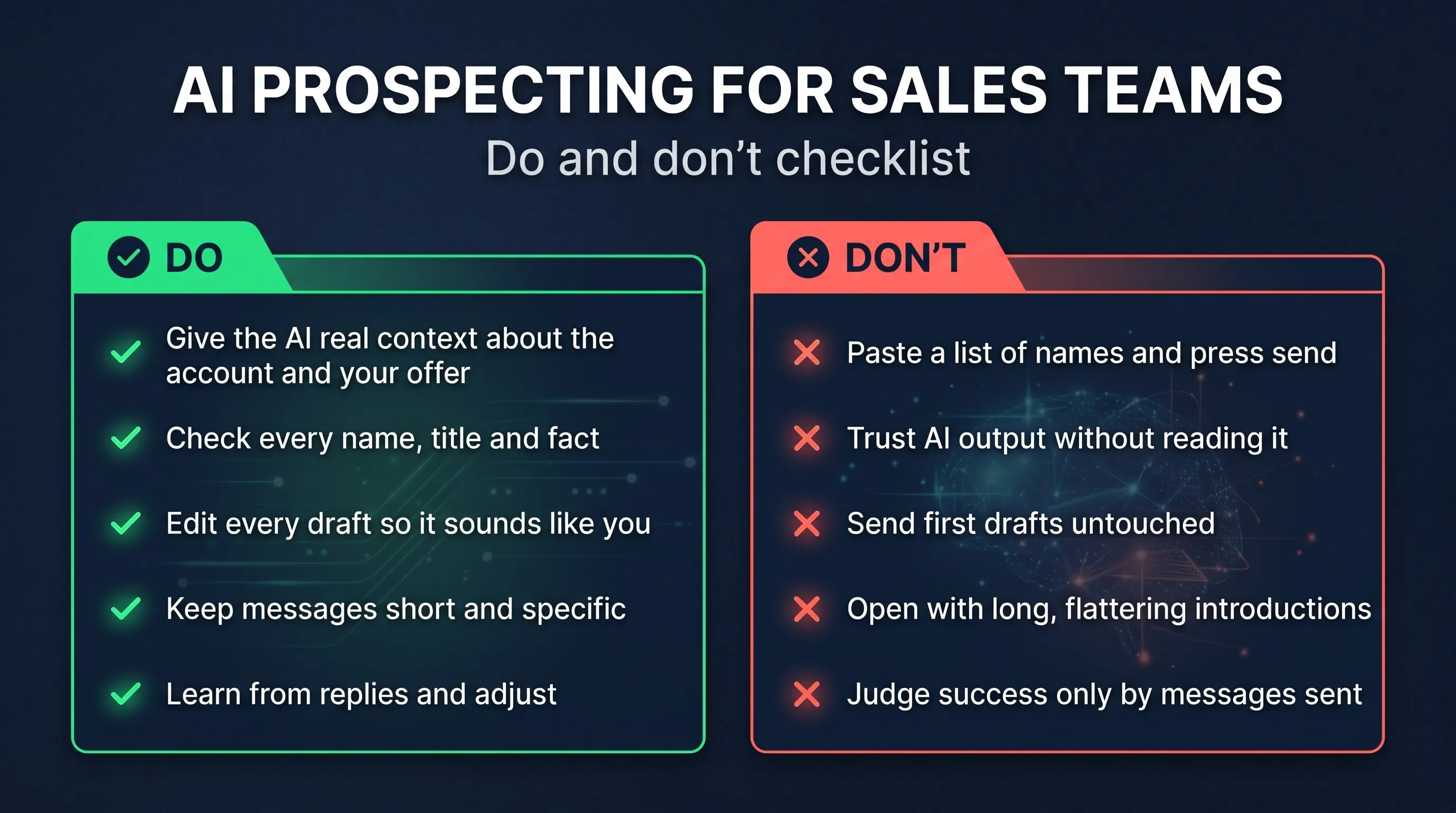
AI outreach sounds robotic when the tool has little real context to work with. It fills the gap with generic praise and vague claims. Better prompts help a little, but better input helps more: a clear reason to contact this person, based on real research, and a human edit before anything is sent.
Watch for these warning signs in your team's messages:
The opening line is flattery with no point behind it
The message could be sent to a hundred companies without changing a word
It talks about the seller's product before the buyer's situation
It makes big claims with nothing specific to support them
It is long, polished and impossible to answer in one line
If a message could be sent to any company, it is not personalised. It is just filled in.
Buyers notice this quickly. A short, specific message that shows you understand their situation will always feel more human than a long, perfect one.